If you run a recruitment agency, your CRM is your business. It’s where candidates live, client relationships are tracked, placements are managed, and revenue is forecast. Yet many agencies still use generic CRMs (HubSpot, Pipedrive) or clunky legacy systems that weren’t built for recruiting. We compared the 9 best recruitment agency CRMs in 2026 to help you choose the right one.
What Is a Recruitment CRM?
A recruitment CRM is software for managing relationships with candidates — and, for agencies, with clients. It holds every candidate you have found or spoken to, the history of each conversation, the roles they were considered for, and reminders to follow up. Agency-grade recruitment CRMs add the client side: companies, contacts, briefs, placements, fees and invoices.
Recruitment CRM vs ATS. An applicant tracking system manages people who apply to a job, from application to hire. A recruitment CRM manages people before and beyond a single job: passive candidates you source, talent pools you keep warm, clients you sell to. Most agency tools now do both — the useful question is which side a product was built for. Our CRM vs ATS guide covers the difference in detail.
What a recruitment CRM costs. From $15 per user per month for budget tools like Manatal, through roughly $95–$150 per user for agency CRMs like Recruit CRM and Recruiterflow, to quote-only enterprise systems — see the comparison table below.
What Makes a CRM “Agency-Grade”?
Recruitment agencies need capabilities that generic CRMs don’t offer:
- Dual pipelines: Track both candidates AND clients/jobs simultaneously
- Candidate database: Store, search, and rediscover past candidates for new roles
- Client management: Track client contacts, contracts, fees, and placement history
- Sourcing integration: Import candidates from LinkedIn, job boards, and other sources
- Outreach automation: Email sequences, follow-ups, and candidate nurturing
- Placement tracking: Manage offer stages, start dates, fees, and guarantees
- Revenue reporting: Forecast placement fees, track KPIs per recruiter, analyze profitability
The 9 Best Recruitment Agency CRMs in 2026
1. MindHunt AI — Best for AI-First Recruitment Agencies
MindHunt AI puts AI candidate sourcing, outreach, a Kanban pipeline, a job board with AI screening, and a client CRM with invoicing in one tool — built by a recruiter with 20 years of agency experience. Paste a job description and AI fills in the search, with a free count of matching profiles before you spend a credit. For outreach, AI writes a personal intro for each candidate from the job description and their profile, inside your own email template, and the sequence stops when the candidate replies.
- Key features: AI search from a job description with a free match count, search through your own LinkedIn account (paid plans), LinkedIn Chrome extension, verified email and phone enrichment, email sequences from Gmail or Outlook, Telegram, LinkedIn and WhatsApp messages from the candidate profile, Kanban pipeline with Offer and Hired stages, company job board with screening questions and AI-scored applications, apply-by-email from any job board, client management with offices and contacts, invoices from placements, a standard report per position you can share with clients
- Pricing: From $29/month (Pro $49/month, with search and contact credits included). Free plan available.
- Best for: Solo recruiters and small agencies doing executive or specialist search
2. Recruit CRM — Best Overall for SMB Agencies
Recruit CRM is the highest-rated recruiting CRM on Capterra (4.9/5, 445+ reviews) and consistently ranks #1 for small-to-mid staffing firms. Its custom Kanban workflows, AI parsing, and unlimited free trial make it the easiest to evaluate.
- Key features: Custom Kanban boards, AI resume parsing, candidate/client dual pipeline, email integration, reporting
- Pricing: From $95/user/month (Pro plan). Free trial with no time limit.
- Onboarding: 2–3 hours to get started
- Best for: Agencies with 1–50 recruiters
3. Bullhorn — Best for Large/Enterprise Staffing
Bullhorn is the industry standard for large staffing agencies. It combines ATS + CRM + back-office operations (timesheets, invoicing, payroll) with 300+ integrations and AI-powered analytics.
- Key features: End-to-end ATS/CRM, 300+ integrations, AI analytics, timesheets, invoicing, payroll connectors
- Pricing: From $99/user/month (custom quotes for enterprise)
- G2 rating: 4.1–4.5/5 (1,020+ reviews)
- Best for: Staffing agencies with 50+ recruiters, especially temp/contract staffing
4. Zoho Recruit — Best Budget Option
Zoho Recruit offers a solid ATS + CRM combo at the most affordable price point, with 5,000+ integrations via the Zoho ecosystem. Free tier available for solo recruiters.
- Key features: ATS + CRM, resume parsing, client/candidate portals, mobile apps, Zoho ecosystem integration
- Pricing: Free tier available. Paid from $25/user/month.
- Rating: 4.4–4.9/5
- Best for: Budget-conscious agencies wanting a full-featured CRM
5. Recruiterflow — Best for Growing Teams
Recruiterflow is designed specifically for recruiting agencies, with a Chrome extension for LinkedIn sourcing, customizable workflows, and strong automation. It hits the sweet spot between simplicity and power. See our full Recruiterflow review.
- Key features: Chrome extension, customizable workflows, email sequences, reporting, team collaboration
- Pricing: $149/user/month (Platform plan); the AIRA plan with AI agents is quote-only
- Capterra rating: 4.8/5 (332 reviews)
- Best for: Growing agencies with 5–50 recruiters
6. Vincere — Best for Global Mid-Market
Vincere is an ATS + CRM built for recruitment agencies operating across multiple markets. It includes AI matching, analytics, and payroll integrations for international staffing.
- Key features: ATS + CRM, AI matching, global payroll integrations, analytics, multi-currency
- Pricing: From ~$108/user/month (custom quotes)
- G2 rating: 4.3/5
- Best for: Agencies operating in multiple countries
7. Manatal — Best for Solo Recruiters
Manatal is the most affordable AI-powered recruiting CRM, with social media enrichment, drag-and-drop pipelines, and AI candidate recommendations at just $15/user/month. See our full Manatal review for what each plan includes.
- Key features: AI matching, social enrichment, drag-and-drop pipeline, career page builder, a 700M-profile sourcing database (10 searches a month on Professional), 14-day free trial
- Pricing: From $15/user/month (Professional) to $35/user/month (Enterprise)
- Best for: Solo recruiters and very small agencies
8. Gem — Best Sourcing-Heavy CRM
Gem combines the strongest sourcing capabilities with CRM and (optionally) ATS in one platform. With 800M+ profile search, AI agents, and drip campaigns, it’s ideal for agencies that do heavy outbound sourcing.
- Key features: 800M+ profile sourcing, AI agents, drip campaigns, pipeline analytics, 50+ ATS integrations
- Pricing: Staffing plans from $99/user/month (Essentials) to $149/user/month (Professional)
- Best for: Sourcing-focused agencies with 3–10 recruiters
9. Greenhouse — Best for Structured Hiring
Greenhouse is a premium ATS/CRM with 500+ integrations, structured interview scorecards, DEI tools, and onboarding capabilities. It’s designed for companies that want a rigorous, process-driven hiring approach.
- Key features: Structured hiring, scorecards, 500+ integrations, DEI tools, onboarding
- Pricing: Custom (quote-based, typically $6,000+/year)
- Best for: Mid-to-large agencies with compliance requirements
Full Comparison Table
| CRM | Starting Price | Rating | Best Feature | Best For |
|---|---|---|---|---|
| MindHunt AI | $29/mo (Pro $49) | — | AI sourcing + client CRM + invoicing | AI-first agencies (solo–20) |
| Recruit CRM | $95/user/mo | 4.9/5 | Custom Kanban + AI parsing | SMB agencies (1–50) |
| Bullhorn | $99/user/mo | 4.1–4.5/5 | End-to-end operations | Enterprise staffing (50+) |
| Zoho Recruit | Free / $25/mo | 4.4–4.9/5 | Price + Zoho ecosystem | Budget agencies |
| Recruiterflow | $149/user/mo | 4.8/5 | LinkedIn Chrome ext + workflows | Growing teams (5–50) |
| Vincere | ~$108/user/mo | 4.3/5 | Global payroll + multi-currency | Global agencies |
| Manatal | $15/user/mo | High | AI matching at lowest price | Solo recruiters |
| Gem | $99/user/mo | 4.7–4.8/5 | 800M+ sourcing + AI agents | Sourcing-heavy agencies |
| Greenhouse | Custom | High | Structured hiring + 500+ integrations | Process-driven agencies |
Which CRM Should You Choose?
| If you are... | Choose... | Why |
|---|---|---|
| AI-first agency, executive/specialist search | MindHunt AI | Sourcing + pipeline + client CRM + invoicing in one, from $29/mo (Pro $49) |
| Solo recruiter, tight budget | Manatal or Zoho Recruit | $15–$25/mo with full CRM features |
| SMB agency (1–50 recruiters) | Recruit CRM | Highest-rated, fastest to set up, unlimited trial |
| Growing agency (5–50) | Recruiterflow | Best balance of power and usability |
| Large staffing firm (50+) | Bullhorn | Industry standard, end-to-end operations |
| Global agency | Vincere | Multi-currency, global payroll integrations |
| Heavy outbound sourcing | Gem | 800M+ sourcing + CRM in one platform |
The All-in-One Alternative: MindHunt AI
Most agency CRMs are strong on client and pipeline management but weaker on outbound candidate sourcing — and sourcing tools don’t handle client relationships. MindHunt AI is built specifically for recruitment agencies and combines both in one platform:
Candidate Side
- AI-powered sourcing: Paste a job description; AI fills the search, every field stays editable, and you see the match count for free
- Contact enrichment: Verified emails and phone numbers
- Outreach: Email sequences that stop on reply, plus Telegram, LinkedIn and WhatsApp messages from the candidate profile
- Inbound: A company job board with screening questions, an apply-by-email address for any job board, and AI scoring of every application
- Visual Kanban pipeline: Customizable stages per position, through Offer and Hired
Client Side
- Client management: Organisations with multiple offices and contact persons
- Shareable reports: Give clients a link to each position's report — funnel, sources, rejection reasons, time in stage and offer acceptance rate — instead of status-update emails
- Invoice generation: Create invoices with line items auto-populated from placed candidates
- Document storage: Contracts, NDAs, and proposals per client
For agencies that don’t need the full enterprise overhead of Bullhorn or Vincere, MindHunt AI delivers the essentials — sourcing, candidate pipeline, client CRM, and invoicing — in one tool from $29/month.
CRM Best Practices: Get More From Whichever Tool You Choose
The CRM you pick matters less than how disciplined your team is in using it. An agency that switches tools without changing process gets the same results with a new invoice — the software is a multiplier on process, not a replacement for one. The practices below are what disciplined usage actually looks like; for the cited industry data on what pipeline automation does to time-to-hire and cost-per-hire, see the stats table in our AI automated recruiting guide.
Pipeline and Data Discipline
- Standardize your pipeline stages — Sourced → Contacted → Engaged → Screening → Interviewing → Offer → Hired → Nurture — so status is comparable across recruiters and roles.
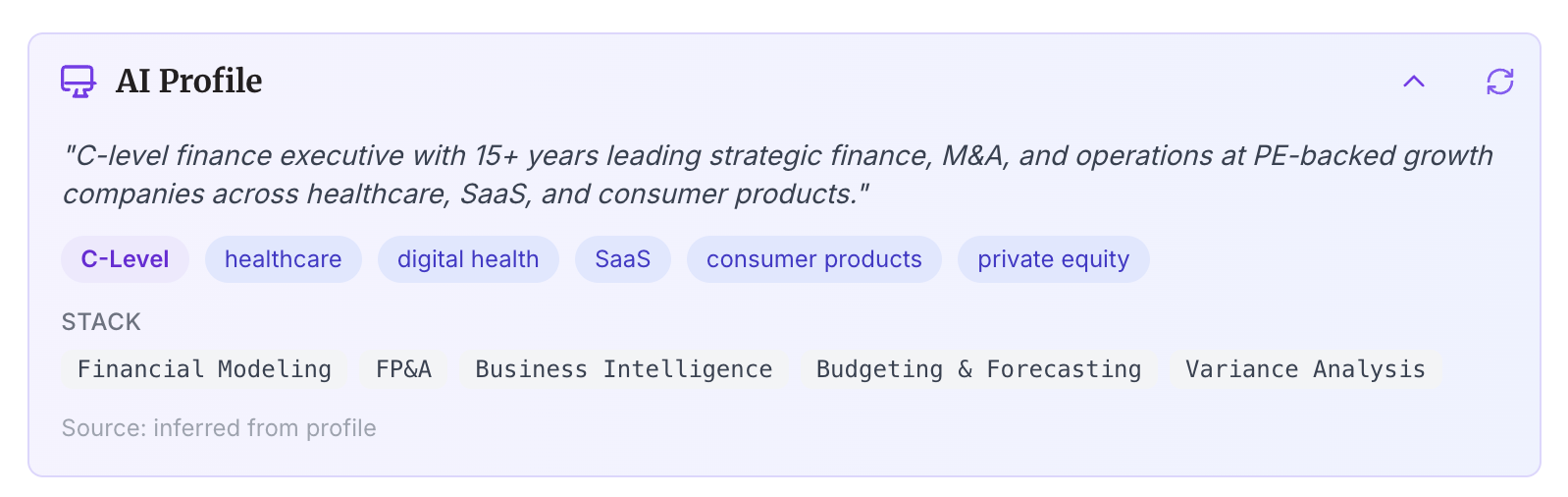
- Enforce one tag taxonomy across the team. If one consultant tags a candidate “CFO” and another uses “C-level Finance,” searches miss half the database. A platform that generates tags automatically from each candidate’s actual background (as MindHunt AI does) removes the inconsistency entirely.
- Keep data clean: archive candidates inactive over 2 years, remove duplicates, and update status within 24 hours of any change — a CRM full of stale records is worse than no CRM.
Automation That Actually Matters
- Automate status updates on trigger events (reply received, screen scheduled, offer sent) instead of manual pipeline edits — a pipeline that depends on someone remembering to drag cards is stale by Friday.
- Run a real follow-up sequence, not one email. 70% of positive responses come after a follow-up, yet most recruiters send a single message. A basic Day 0 / Day 3 / Day 7 / Day 14 sequence with a different angle each touch outperforms a single blast.
- Score candidates on skills match, seniority fit, and engagement level so your team spends time on the 20% of the pipeline worth prioritizing, not the whole list equally.
Build Pools, Not Just Pipelines
- Nurture passive candidates on a cadence (monthly value-add touches, quarterly opportunity shares) — the best candidates aren’t actively looking, and relationships built before you need them convert far better than cold outreach.
- Build talent pools by role before you have an opening. When a position lands, 50–100 warm candidates already tagged and ready means the search starts on day one — not after two weeks of cold sourcing.
- Track engagement metrics (email response rate, phone-screen show rate, offer acceptance rate) — data-driven recruiting beats gut feeling, and the metrics tell you exactly which stage is your bottleneck.
The most common failure mode isn’t picking the wrong tool — it's treating a CRM like a spreadsheet (storage without relationship management), inconsistent team usage, or never building talent pools proactively. A CRM only pays off when the whole team actually uses it the same way.
Client Reporting: What to Share and How Often
The client side of an agency CRM is only as good as what you send out of it. Clients rarely see your sourcing effort, so the pipeline data your CRM already holds is the fastest way to show progress, justify the fee and make hard conversations factual. Three groups of metrics cover it:
Activity metrics — show your effort
| Metric | What It Shows | Why Clients Care |
|---|---|---|
| Candidates sourced | Research and sourcing effort | Shows you're actively working |
| Candidates contacted | Outreach volume | Demonstrates a proactive approach |
| Response rate | Message effectiveness | Shows the quality of outreach |
| Channels used | Sourcing diversity | Proves a comprehensive search |
Pipeline metrics — show progress
| Metric | What It Shows | Why Clients Care |
|---|---|---|
| Candidates by stage | Pipeline health | Where candidates are right now |
| Stage conversion rates | Funnel efficiency | Identifies bottlenecks |
| Time in each stage | Process speed | Highlights delays (often client-side) |
| Candidates declined / withdrew | Market feedback | Why candidates drop out |
Outcome metrics — show results
| Metric | What It Shows | Why Clients Care |
|---|---|---|
| Interviews scheduled | Qualified candidates delivered | Direct business impact |
| Offers extended | Search nearing completion | Light at the end of the tunnel |
| Time-to-fill progress | Search efficiency | Against benchmarks and expectations |
| Market insights | Talent availability | Informed hiring decisions |
Cadence: weekly updates on an active contingency search, a detailed bi-weekly report on retained work, same-day notice for major developments — and an update in slow weeks too, because silence breeds anxiety. Most agency CRMs export these numbers; MindHunt AI's client CRM shares a position's live pipeline analytics with the client by link, no login required.
Data makes difficult conversations easier. "We contacted 200 candidates and 5% replied" points at compensation or requirements, not effort. Candidates dropping at the interview stage points at the interview process or culture. A high response rate followed by lost interest once candidates learn more points at the role description. Each of those is a conversation about the client's side of the funnel — and the numbers let you have it without it becoming personal.
Related Resources
- MindHunt AI Client CRM
- CRM vs ATS: What’s the Difference?
- ATS Buyer’s Guide 2026 — what changes when the client pays
- Inbound Recruiting — every client’s applicants from every board in one pipeline
- How to Start a Recruitment Agency
- Best Recruiting Software 2026
- AI Sourcing Tools 2026: 12 Best Compared
- AI Recruiting Software: The Complete 2026 Guide
Supercharge your agency’s sourcing. MindHunt AI pairs with any CRM to add AI-powered candidate search across professional profiles, verified email and phone enrichment, automated outreach via email and Telegram, and visual pipeline management. from $29/month. Start your free trial.